A reader recently asked about my use of literary cubism in Resolution 786. The reader's question and my answer follow -
The reader asked:
Dr. Mughal,
Thank you so much for being willing to answer questions. I loved your first book, and hope it means more to come. I think I saw on your Facebook that you have two books in the works - one fiction and one nonfiction about writing. When are they coming out?
What I'd really like to know about Resolution 786 has to do with it's style. It seems Literary Cubism is a very interesting choice considering the fact that much of the meat of the story has to do with Adam's literal understanding of things. His way of thinking and viewing the world seems in juxtaposition to the style of the book, which for me made it more "alive" and "real" and "three dimensional" if that makes sense. The intense contrast between the nature of the main character and the style of the book adds to the intrigue. Was this intentional? Accidental? Can you elaborate a bit?
Thanks!
A. Reader
Mohamed answered:
Dear Reader,
First, about the two books that I have in the works - I expect and hope to have both drafted by the end of 2010. As for when they’ll be “coming out” for public consumption, we’ll see….
On your question about the contrast between the nature of the main character in Resolution 786 and the style of the book: I had never thought of it!
Yes, Adam Hueghlomm has a linear, literal mind that’s steeped in logic. Yes, on the contrary, literary cubism is a non-linear multivariate mode of viewing and telling a story from different perspectives through the use of various written media, a method of writing that’s free from any strictures of temporal propriety.
Was the juxtaposition between the nature of the main character and the style of the book intentional? No. Not at all.
Was it accidental? Not entirely.
Keep in mind, as a writer, my background is that of an Indian born in Africa and raised in the United States; a child born into Islam who has had the privilege of studying and experiencing Christianity, Judaism, Buddhism, Hinduism, Masonry and New Age thought; a chemical engineer dabbling in the humanities, theology and philosophy.
I am an amalgam of influences. It is inevitable that my written works will reflect those many sources of learning and experience. Thinking through both your question and my answer, I realize now that literary cubism is perhaps the ONLY mode of literary expression for a person with such a patchwork of geographical, theological and educational background.
No, in retrospect, my choice to use literary cubism to write Resolution 786 wasn’t to create a non-linear juxtaposition for Adam Hueghlomm’s linear intellect. Rather, I think it was a demonstration of who I am as a person and, more importantly in this context, who I am as a writer.
Wednesday, June 16, 2010


Sunday, June 13, 2010
Write With Your Six Senses
Be a keen watcher. Be a sponge. Scan the people and the animals around you for gestures, expressions, habits, poses. Once you've honed your personal second nature for seeing, expand your sensory collection to your other four senses: hearing, feeling, smelling and tasting. Hear the unique inflections, patterns and dialogue in the conversations around you; feel the intoxicating plethora of tactile sensations during love-making; smell the evening jasmine in your father's garden; taste the grit of a desert sandstorm. All of these sensations, so many and so varied, are an invaluable cache of experiential fodder from which to build a richness of description into your writing. They provide a linguistic superstructure that bestows a three-dimensional reality to your scenes. They inform and influence everything in the composition of your fiction from dialogue to character to setting. In short, they are an essential component to giving your readers a convincing, emotionally engaging, full-fledged experience of the events in your narrative, a potent means through which to help your readers meet your characters.
Keep in mind, writing fiction is truly a creative process. Don't limit yourself to just reporting your collected experiences. Throw them into a box, shake the box around and see what kinds of interesting and contextually appropriate new syntheses you can form. I had a vignette where a character was surprised and bewildered. The second sentence in the scene is: "Crashing cymbals of bright radiance clanged before his eyes." Radiance is seen. Clangs are heard. Yet the dazed character "sees" the clang of cymbals. The discordant merging of sensory experience conveys the disorientation intrinsic to the vignette and it gives your readers an interesting, multi-sensory image to consider.
OK. I've made the case that your five mortal senses will give you more than enough material with which to weave a rich tapestry of description into the fabric of your stories.
But there's a sixth sense.
Strictly linear thinkers need not read further. Skip to the next post. The rest of you, please come this way...oh, and watch the little, dancing wood nymphs around your feet, young man. They're fragile and they don't appreciate being stepped on.
I've felt and experienced sensations beyond the traditional five senses. If any of you have "seen" inside the psychology of strangers walking past you at the mall or heard your pet's thoughts or watched a window shatter before your eyes for no reason or felt an empty kitchen blow dry, frigid air onto the back of your neck in the quiet stillness of a bright winter day, then you know what I mean. Unless one of these experiences is deeply personal or has an essentially private nature, consider including a description of it in your fiction. There's a first-person description of the afterlife in one of my novels. Yes, the novel's fiction. But almost the entirety of that vision is someone's actual experience.
Use your senses as a tool for creative writing...use all six of them.
Thursday, June 10, 2010
What's in Your Writing Process?
Readers send me questions from time to time. Here's one about my writing process -
Baddestbadass asked:
I guess as someone that has great procrastination tendencies, I wonder how the process of writing a book is for different people. For you is it something you start when other parts of your life are quiet and you hibernate til it's done, or do you write whenever you can...? what is your writing process like and do you have specific writing rituals?
Looking forward to reading your new stuff.
Baddestbadass
Mohamed's answer:
Dear Baddest Badass,
Considering your name, I think it best that I indulge your question with a quick answer…or else pay a heavy price (smile).
I can relate with great procrastination. When my tenth grade English teacher (Mr. Green) asked what I wanted to be, I said, “Writer.” Thirty years later, I’m finally writing. Now that’s procrastination!
My writing process is non-process. I like to open my mind and let ideas flow; I put the ideas into words and then move the words around to create themes. Some work. Some don’t. I throw out what doesn’t work; I nurse what does.
I write because I have to, so I MAKE the time to write and I consciously preserve my creative energies for imaginative composition. If I waited to write till my life was quiet, years from now they’d be burying a fellow who always said that he wanted to be a writer but who didn’t write.
“hibernate til it’s done,” you ask. I only wish! That’s indeed my fantasy, to write the great American novel ensconced in solid, delicious isolation…but then…fragments of real-world existence intrude on the fantasy, life’s incidentals, things like: work, bills, the wife, social obligations, maintaining personal health (physical, emotional, intellectual and spiritual). I write in the middle of it all, despite it all.
No, I don’t have any writing rituals. The only “act” that counts is moving fingers on a keyboard. If that counts as ritual, that’s mine.
Thank you for reading my work. And please don’t give up on writing. It’s an opportunity to create art. We are at no time closer to Creator than when we ourselves are creating, than when we passionately tap the gifts of our own artistic expressiveness.
Take care, my friend!
Mohamed
Sunday, June 6, 2010
Creating Characters
Tabitha Olsen's blog, Writer Musings, had an instructive post on using Character Worksheets. I'll take this tool out for a test-run the next time I'm working on a new piece of writing.
I wonder if the Lord used something similar when he created Adam? :)
I wonder if the Lord used something similar when he created Adam? :)
Saturday, June 5, 2010
Writing Science Fiction - Two Lessons from Arthur C. Clarke’s “2001: A Space Odyssey”
Having enjoyed Stanley Kubrick’s movie of the same title, I decided that it was time to read Arthur C. Clarke’s novel 2001: A Space Odyssey. What a well-written novel brimming with so many intriguing ideas! As I placed the finished book on my nightstand, two things stood out in my initial impressions:
1. Clarke does a splendid job of describing the beauty and grandeur of nature. Here’s the fascinating twist: he doesn’t have first-hand personal experience with the natural phenomenon that he so artfully describes. Yes, we’ve all read and written literary impressions of brilliant sunsets and peaceful dawns. Now, to write equally evocative passages about an earth-rise on the moon or about noiselessly sailing through the rings of Saturn…you get the point; in science fiction, many times you’re writing of things that you’ve never seen.
2. 2001: A Space Odyssey was copyrighted in 1968. The world’s population was roughly 3.556 billion that year. In the text of his novel, Clarke makes reference to the population of the Earth in 2001: “…six billion people….” Want to guess the actual global population in 2001? It was 6.1 billion people. Good guess? I doubt it. With first-class degrees in mathematics and physics from King’s College, London, I’m sure that Clarke must have run demographic numbers to get such an accurate forecast of the total global population thirty-three years into the future.
Taking mental inventory of the points above, what lessons have we learned about writing science fiction? There are two. First, be prepared to violate that age-old, well-worn axiom of writing that tells us to “write what you know.” The events and physical circumstances of science fiction often will take you to the brink of the unknowable. By necessity, you’ll have to write beyond what you know. Second, no matter how outlandishly speculative your core premise for a particular piece of writing might be, in the end the best science fiction gestates around a superstructure of science fact. Take the time to do the necessary research to create plausible settings of scientific truth and your readers will be much more likely to reward you with a temporary suspension of disbelief, that psychological opening that compels them to continue reading despite your narrative’s eventual introduction of: ETs; waking up an insect; living forever; time travel; putting God on trial for crimes against humanity.
Wednesday, June 2, 2010
Vonnegut Declines
I created a comic strip a few years back. The strip's titled Dr. Mohamed. Its title character is an American Muslim engineer with a philosophical disposition, a bi-sexual Jewish girlfriend, a dog named Buck, and an archenemy named Comet Kohoutek. Comet Kohoutek, a former heavy-metal bass player, is now a fundamentalist American Muslim convert who's repulsed by Dr. Mohamed's liberal lifestyle. The 24 strips that I completed revolve around themes of social and religious commentary with side helpings of quantum physics and special relativity.
I asked Kurt Vonnegut if he might be interested in collaborating on future strips of Dr. Mohamed. He declined in the postcard below:

I can't imagine Vonnegut not being funny enough for Dr. Mohamed. I just can't imagine :)
I asked Kurt Vonnegut if he might be interested in collaborating on future strips of Dr. Mohamed. He declined in the postcard below:
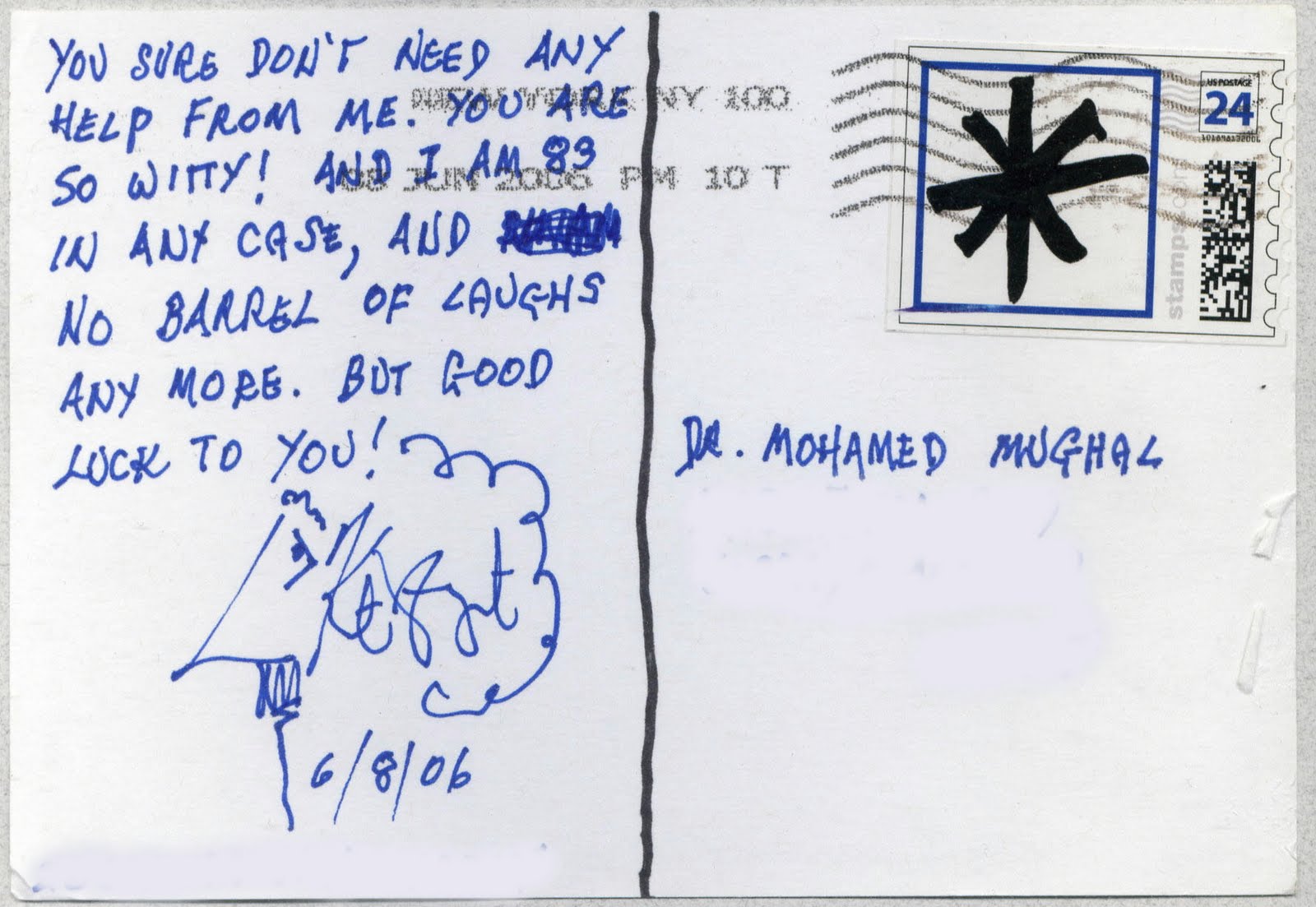
I can't imagine Vonnegut not being funny enough for Dr. Mohamed. I just can't imagine :)
5 Things for Which I'm Grateful
An intimate recently became exasperated with my most current regression into melancholy. Her prescription: make a list of 5 things that you're grateful for; when you feel a slip to melancholy, pull out the list and read it.
Wow.
I want to see if this works. First things first; I need to write the list.
Here goes:
1. Sex
2. Art (experiencing and creating)
3. Peacefulness
4. A family who loves me
5. Being an American
Wow.
I want to see if this works. First things first; I need to write the list.
Here goes:
1. Sex
2. Art (experiencing and creating)
3. Peacefulness
4. A family who loves me
5. Being an American
Subscribe to:
Posts (Atom)